
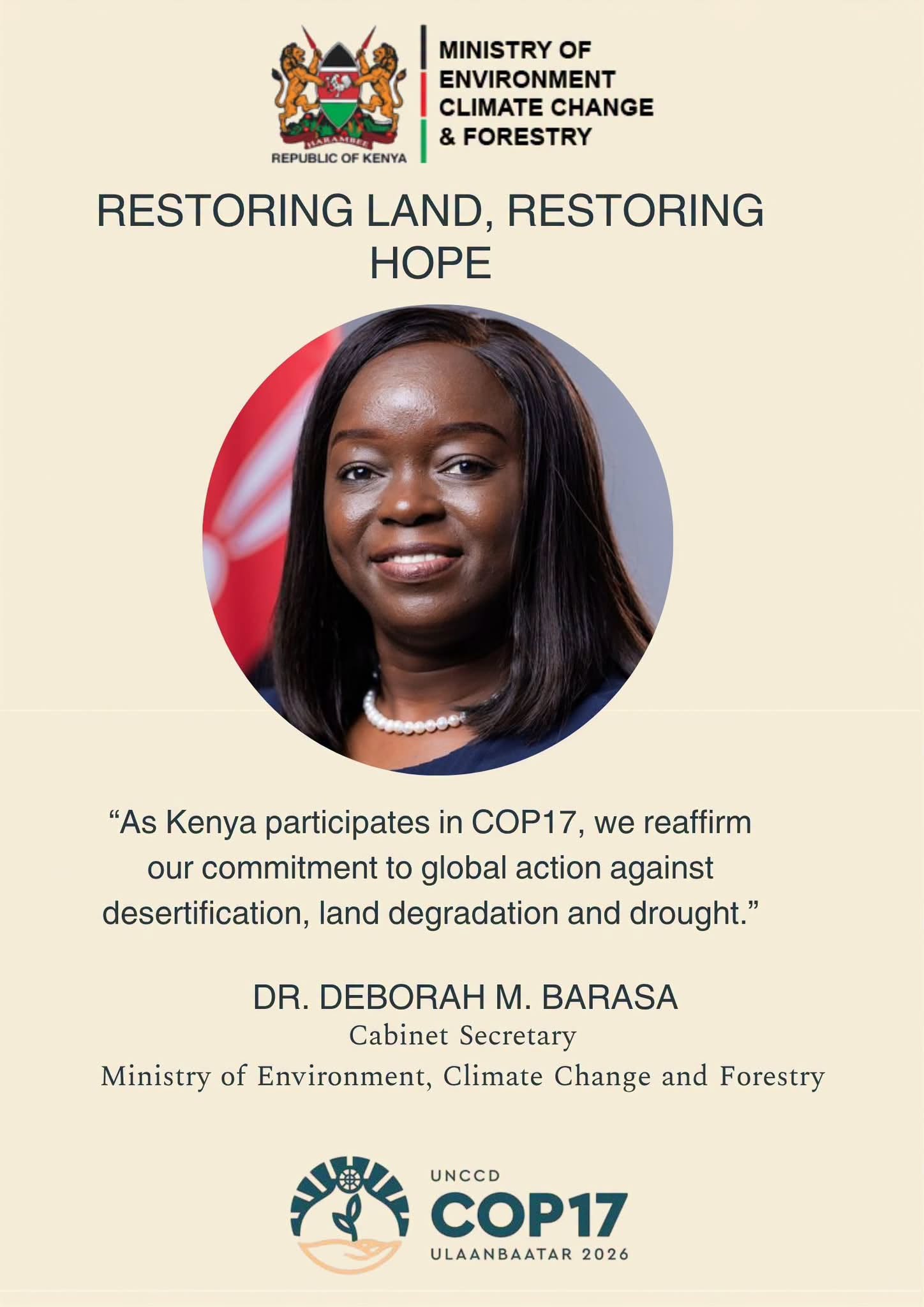
COP17’s Call to Restore Land Resonates with Kenya’s KEWASIP Agenda
The 17th session of the Conference of the Parties (COP17) to the United Nations Convention to Combat Desertification (UNCCD) is taking place in Ulaanbaatar, Mongolia, under the theme “Restoring Land. Restoring Hope.
The conference brings together governments, scientists, civil society, communities, Indigenous Peoples, pastoralists, farmers and development partners to advance practical solutions to desertification, land degradation and drought, with a strong focus on land restoration, drought resilience, water, rangelands and sustainable food systems.
At its core, COP17 recognizes that land restoration is not only an environmental imperative but also a development and livelihoods priority.
Healthy landscapes provide food, water, productive soils, biodiversity and economic opportunities.
This global conversation closely resonates with Kenya’s own landscape restoration priorities in alignment with the National Landscape and Ecosystem Restoration Strategy 2023-2032, which targets the restoration and conservation of 10.6 million hectares of degraded landscapes and ecosystems by 2032 through the 15 Billion Tree Growing Initiative and cascading to the objectives of the Kenya Watershed Services Improvement Project (KEWASIP).
The project’s Development Objective is to expand the area under sustainable land and watershed management and improve the livelihoods of communities in the project areas.
The message emerging from COP17 is clear; restoration must move from commitments to implementation, and from global platforms to action on the ground.
This means investing in communities, strengthening local institutions, applying science and indigenous knowledge, improving water and land management, and ensuring that restoration delivers tangible benefits to people.
KEWASIP provides a practical pathway for translating these principles into action in Kenya.
The project uses an integrated watershed approach that combines sustainable land and watershed management, ecosystem restoration, participatory planning and livelihood diversification.
It places communities at the center of landscape restoration while strengthening institutions responsible for planning, governance and monitoring.
The project is being implemented across five priority watershed landscapes representing diverse ecological systems and communities —Marsabit, Marmanet, Nyambene, Chyulu Hills and Shimba Hills—covering twelve counties: Marsabit, Samburu, Garissa, Isiolo, Baringo, Meru, Tharaka Nithi, Tana River, Laikipia, Kitui, Makueni and Kwale.
KEWASIP will support communities to apply Sustainable Land and Watershed Management (SLWM) practices and technologies suited to local landscapes.
These interventions are designed not only to restore degraded land, but also to improve agricultural productivity, conserve water, strengthen ecosystems and enhance community resilience to climate change.
The key practices targeted for KEWASIP in alignment to the agenda of COP 17 include rangeland management, soil and Water Conservation measures and promotion of agroforestry value chains.
The project will focus on restoration of selected rangelands through reseeding, construction of water storage structures and promotion of gums and resins value chains for livelihood enhancement in ASAL counties.
This will support pasture recovery, reduce pressure on fragile ecosystems and strengthen pastoralist livelihoods reflecting the broader priorities being advanced at COP17- sustainable rangeland management, drought resilience, water security and restoration of agricultural land.
COP17 is also taking place during the International Year of Rangelands and Pastoralists 2026, providing an important opportunity to strengthen recognition of the role of rangelands and pastoralist communities in sustainable land management.
KEWASIP therefore goes beyond planting trees. Its approach is centered on restoring the functionality of entire landscapes and watersheds while enabling communities to benefit from improved ecosystem services and diversified livelihoods.
The project is expected to benefit approximately 750,000 Kenyans and create about 25,000 jobs, demonstrating the link between environmental restoration and economic opportunity.
The restoration agenda also contributes directly to Kenya’s broader development priorities, including the Bottom-Up Economic Transformation Agenda (BETA).
Kenya’s participation in COP17 provides an opportunity to share the country’s experiences, priorities and solutions while learning from global approaches to combating desertification, land degradation and drought.
The Cabinet Secretary for Environment, Climate Change and Forestry, Dr. Deborah Mlongo Barasa, EGH, is participating in COP17 in Ulaanbaatar, alongside government officials, technical experts, civil society organizations and international partners.
Kenya’s engagement comes at a critical time as the country accelerates implementation of its landscape and ecosystem restoration agenda.
The global call from Ulaanbaatar therefore reinforces an important national message: restoration must be people-centered, locally led and capable of delivering lasting environmental and socio-economic benefits.
KEWASIP demonstrates how international commitments on land degradation and drought resilience can be translated into practical action at the community level.
The connection between COP17 and KEWASIP is therefore more than a shared commitment to land restoration.
It is a shared recognition that the health of landscapes and the well-being of communities are inseparable.
As the world gathers in Ulaanbaatar under the banner “Restoring Land. Restoring Hope,” Kenya is acting at home to turn this aspiration into measurable results.